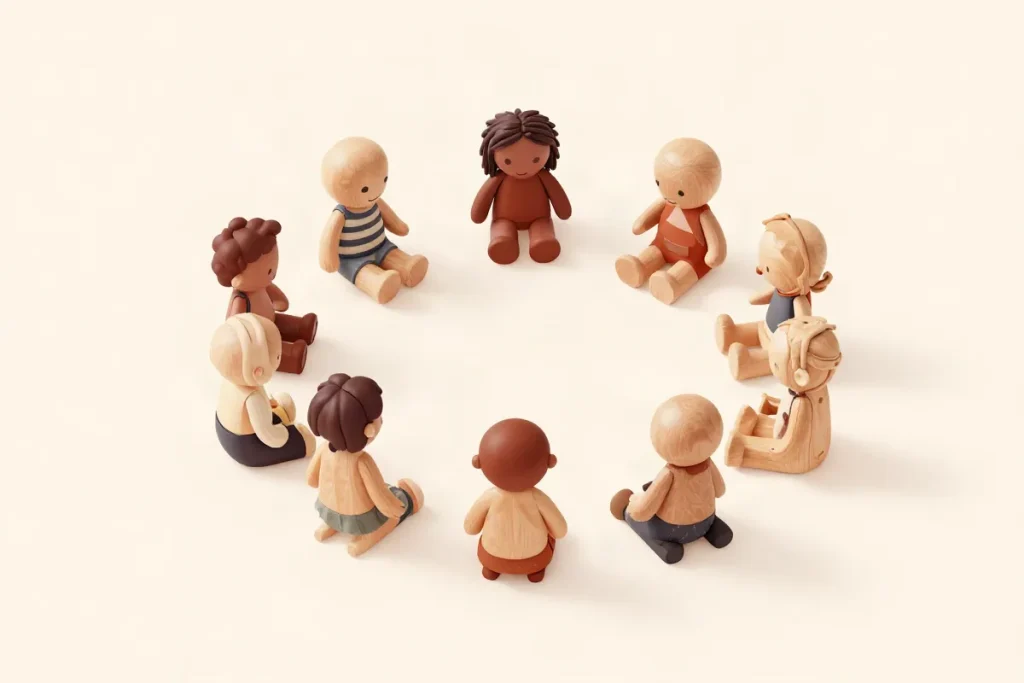
Introduction: Why Choosing the Right Toys Matters for Cooperative Play
Toys for toddlers aged 2–3 should do more than just entertain—they should help develop skills for cooperative play and peaceful interaction. This is a crucial stage for building communication and social abilities, and well-chosen toys can be the key to teaching children how to play together, share, and resolve conflicts successfully. According to a 2026 study by the Institute of Childhood at the Russian Academy of Sciences, 68% of children in this age group who play with educational toys show higher levels of empathy and communication skills.
Criteria for Selecting Toys That Foster Cooperative Play
When choosing toys for toddlers, it’s important to consider specific factors that ensure both effectiveness and safety.
Main Criteria
- Age Appropriateness: Toys should be designed specifically for ages 2–3, taking into account the child’s motor skills and attention span.
- Material and Safety: Preference is given to natural materials—wood and cotton—that provide tactile sensations and are non-toxic. For example, a wooden construction set from «PlanToys» costs about 2500 ₽ per set.
- Encouraging Communication: Toys should promote joint activities—such as puzzles and board games with simple rules.
- Skill Variety: Toys that develop multiple skills at once: motor skills, speech, attention.
- Ease of Use: The toy should be understandable to the child to avoid frustration and conflicts.
| Model | Material | Price (₽) | Skills | Cooperative Play |
|---|---|---|---|---|
| PlanToys Constructor 30 pcs. | Wood | 2500 | Motor skills, logic | High |
| Melissa & Doug Puzzles «Farm» | Cardboard | 1500 | Attention, speech | Medium |
| Hape Musical Instrument «Duet» | Wood, fabric | 3200 | Hearing, coordination | Very high |
- 68% of 2–3-year-olds show improved communication skills when using educational toys
- 2500 ₽ average price of a quality wooden construction set
- 3200 ₽ price of a musical set encouraging joint creativity
Toy Materials and Their Role in Developing Interaction
Natural materials play a key role in tactile development, which is crucial for toddlers learning to play together. Toys made from wood and fabric are not only safe but also support sensory perception.
Why Wood and Fabric?
- Wood is durable, eco-friendly, has a pleasant texture, and helps develop fine motor skills.
- Fabric is soft, safe, suitable for role-playing games, and fosters tactile sensations.
According to the 2026 GOST standard for children’s toys, wooden toys must have a smooth surface and contain no toxic dyes, ensuring safety during cooperative play.
Toys That Develop Cooperative Play Skills
To promote cooperative play skills, it’s important to choose toys that require joint actions and communication.
Toy Options
- Board games with simple rules, such as «Catch the Bug» by SmartGames (price about 1800 ₽).
- Musical instruments for two players, like the «Duet» set from Hape.
- Puzzles with large pieces that encourage joint problem-solving—Melissa & Doug.
Toys like these help develop communication skills, turn-taking, and collaborative creativity.
The Role of Parents and Educators in Facilitating Cooperative Play
Toys are just tools; the organization of play by adults is what really matters.
Recommendations for Adults
- Explain game rules in simple words and model the behavior.
- Encourage children to share toys and support each other.
- Set aside time for joint play sessions, for example, 20–30 minutes a day.
A 2026 study by Lomonosov Moscow State University showed that with active adult support, children learn cooperative play skills faster, reducing conflicts by 40%.
How to Assess the Effectiveness of Chosen Toys
Evaluating the effectiveness of toys in developing cooperative play is important for adjusting purchases and teaching methods.
Effectiveness Indicators
- Time spent playing together without conflicts (ideally more than 15 minutes).
- Level of child engagement and interest in the game.
- Emergence of communication skills: requesting, joint planning.
Parents can keep a simple observation diary or use checklists recommended by the «Strong Family» project in 2026.
Frequently Asked Questions
What toys are best suited for 2-year-olds?
How can I tell if a toy encourages cooperative play?
Is it worth buying expensive educational toys?
How often should toys be rotated to maintain the child’s interest?
Key Takeaways
- Choose toys made of natural materials designed for ages 2–3.
- Prioritize toys that encourage joint activities and communication.
- Parental support and organizing play greatly enhance toy effectiveness.
- Assess effectiveness by the child’s engagement and conflict-free playtime duration.
- Variety and periodic rotation of toys maintain interest and support development.
Conclusion
Educational toys for toddlers aged 2–3 are an essential tool for developing cooperative play skills and peaceful interaction. When choosing toys, focus on age-appropriate criteria, safety, materials, and the toy’s ability to stimulate communication. The role of parents in organizing and supporting play is just as important as the toy itself. By following these recommendations, you can create a nurturing environment for harmonious child development and stronger family bonds.
Sources
- Happy Parents — “For the Future Genius: Top 10 Educational Toys of 2026”
- dns-magazin.ru — “TOP 10 BEST Educational Toys for Children up to 1-2 Years: Which Toy to Buy?”
- sakhalin.er.ru — “Quiz: ‘Secrets of Educational Toys: Test Yourself!’”
- irkutsk.er.ru — “As part of the party project ‘Strong Family’, a test ‘Secrets of Educational Toys: Test Yourself!’ was prepared”
- mchildren.ru — “Checklist: What to Look for When Choosing Educational Toys for Under 3s”