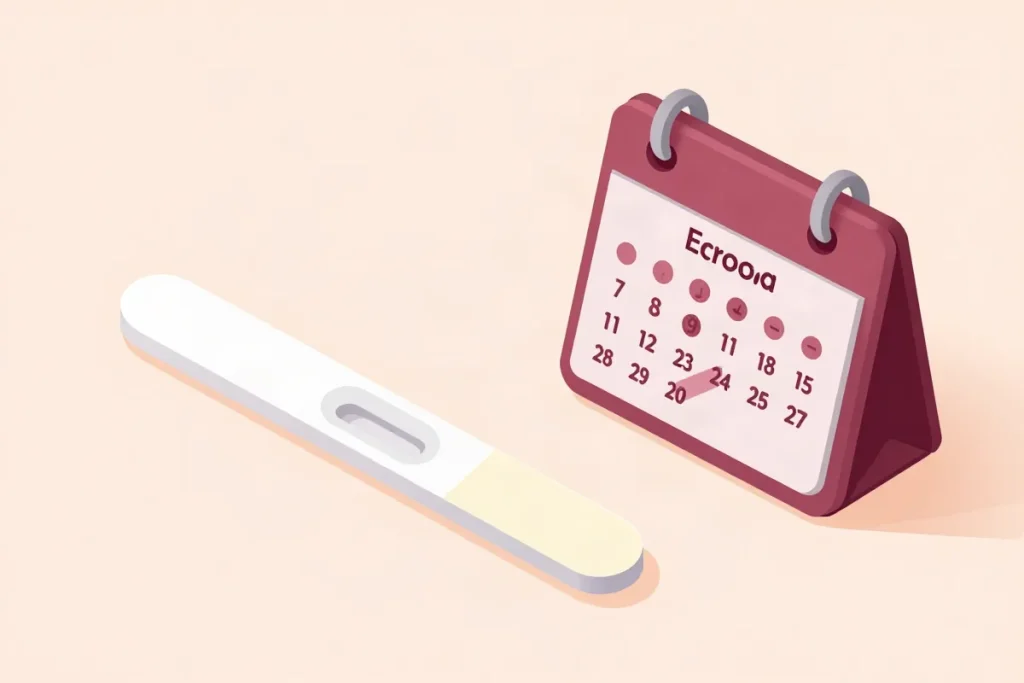
It’s best to take a home pregnancy test from the first day of a missed period: the result is usually more reliable then than when testing in the first few days after possible conception. If the test shows two lines, pregnancy is likely; if it shows one and your period still hasn’t started, repeat the test in a few days.
A pregnancy test detects the pregnancy hormone in urine, but testing too early can give a negative result even if you are pregnant. This article explains when to take a test, how to follow the instructions, and what different results may mean.
| Situation | Next step | Specific guideline |
|---|---|---|
| Test taken before a missed period | Repeat after the missed period | Testing too early may fail to detect hCG |
| Test is negative, period hasn’t started | Repeat the test | In about a week |
| Symptoms are present, result is negative | Repeat the test | In 2–3 days — recommendation from the Complimed article |
| Period is still late | See a doctor | After 2 weeks without a period, the Lekar article recommends an examination |
| Test is expired or instructions weren’t followed | Check the expiration date and how to use it | Both can make the result unreliable |
- 14 days after ovulation, the point at which the Bud Zdorov clinic article says a test can give an answer
- 2–3 days the interval before retesting after a negative result when symptoms persist, as stated in the Complimed article
- about 1 week the recommended interval in the provided summary for repeating a test when there is no period
- 2 weeks without a period, a duration for which a negative test is described as grounds for an examination in the Lekar medical center article
When should you take a pregnancy test to reduce the risk of an early false negative?
To reduce the risk of an early false negative, take a rapid test after a missed period; if you know when you ovulated, use 14 days after ovulation as a guideline. The Complimed article recommends waiting until after a missed period to take a home test, while the Bud Zdorov clinic notes that you can get a “yes” or “no” answer only after 14 days have passed since ovulation.
Why testing too early may not work
A test detects hCG in urine, a hormone that appears during pregnancy. If you test too early, its concentration may not be high enough to detect, so a negative result does not yet rule out pregnancy.
If you don’t know the day you ovulated, wait until your period is late rather than testing early. This practical approach is reflected in the Complimed and Bud Zdorov clinic articles. A result before a missed period may be negative simply because there is not yet enough hCG for the test to detect; testing again after your period is late gives you a more suitable window for an answer.
Does the time of day affect the result?
There is no required time of day to take a pregnancy test: the provided materials do not establish that testing in the morning is more accurate than at other times. It’s more important not to drink a lot of fluid immediately before testing: diluted urine may make hCG harder to detect and increase the risk of a false negative.
This matters especially when testing early: if hCG in your urine is already hard to detect, dilution may affect the result. So focus not on a particular time of day, but on what you do before the test and on following the instructions.
What to check before testing
- Fluids: Don’t drink a lot immediately before testing, as this can dilute your urine.
- Instructions: Different products may have different urine collection methods and different wait times before reading the result; follow the directions for the test you’re using.
Why might a pregnancy test be negative even though pregnancy is possible?
A negative pregnancy test does not always rule out pregnancy: if you test too early, the level of hCG in your urine may be below the detection threshold, while an expired test, failure to follow the instructions, or diluted urine can affect the result.
Mistakes to check before testing again
- When you tested. If you tested early, hCG may not yet have reached the level the particular test can detect. If the result is negative and your period is still late, repeat the test in about a week.
- Expiration date. An expired test may give an unreliable result. Check the date on the package before use.
- How you took the test. Not following the procedure correctly is another possible reason for a negative result. Follow the instructions for the test you’re using.
- How much you drank. If you drink a lot just before testing, your urine may be more diluted, making hCG harder to detect. Avoid drinking a large amount of fluid before testing.
If the next test is also negative and your period still hasn’t started, the delay may have a cause unrelated to pregnancy. The provided information names excessive stress, thyroid problems, and amenorrhea as possible causes; if the delay continues, discuss it with a doctor.
When should you repeat a test after a negative result?
After a negative test, repeat it in about a week if your period still hasn’t started; if pregnancy symptoms persist, repeat it in 2–3 days. These intervals can help you check the result again, but a negative result by itself does not establish the cause of a late period.
A negative result means the test did not detect hCG in your urine. Before testing again, check the instructions and the expiration date: an expired test or using it incorrectly may affect the result. If the result remains negative and your period still hasn’t started, it still doesn’t explain why your period is late.
What should you do if your test is negative but your period still hasn’t started?
If your pregnancy test is negative but your period still hasn’t started, see a doctor: if your period is 2 weeks late, a negative result is a reason to get checked rather than to keep taking home tests indefinitely.
When to seek advice
If you haven’t had a period for 2 weeks, tell your doctor when your last period began, when you took the tests, and what the results were. This information can help you discuss the situation and determine whether you need an examination.
A negative test does not explain why your period is absent. The provided summary names excessive stress, thyroid problems, and amenorrhea as possible causes; discuss with your doctor which, if any, might apply to you.
What can’t a home pregnancy test tell you?
A home test cannot identify the cause of a late period and, by itself, cannot confirm pregnancy: a negative result only means that the test did not detect hCG in your urine. So a single result cannot tell you why your period hasn’t started, and symptoms cannot reliably confirm or rule out pregnancy.
Specific circumstances can make a result less reliable: an expired test, testing too early, not following the instructions, or diluted urine after drinking a lot of fluid. If you test early, hCG may not yet be detectable in your urine; a home test checks for hCG, not for other possible causes of a late period.
If your period is still late
If the test is negative but your period hasn’t started, you can repeat it in about a week — this interval is given in the provided materials. However, repeating the test does not replace a consultation if your period remains late: the cause may not be pregnancy but another condition, including thyroid problems or excessive stress. Don’t conclude that you are or aren’t pregnant based only on nausea, fatigue, or other symptoms: a home test works by detecting hCG in urine.
Frequently asked questions
Can I take a test before my period is late?
When should I repeat a negative test?
Do I have to take the test in the morning?
What should I do if my period is 2 weeks late and the test is negative?
Sources
- apollohospitals.com — “Pregnancy tests: when to take one, accuracy, and results”
- complimed.com.ua — “Pregnancy test: when and how to take it correctly”
- ru.clearblue.com — “Negative pregnancy test — is it definitely accurate? Clearblue”
- Lekar Medical Center in Krasnogorsk — “Missed periods, negative test: causes and what to do”
- klinikabudzdorov.ru — “Pregnancy test”
