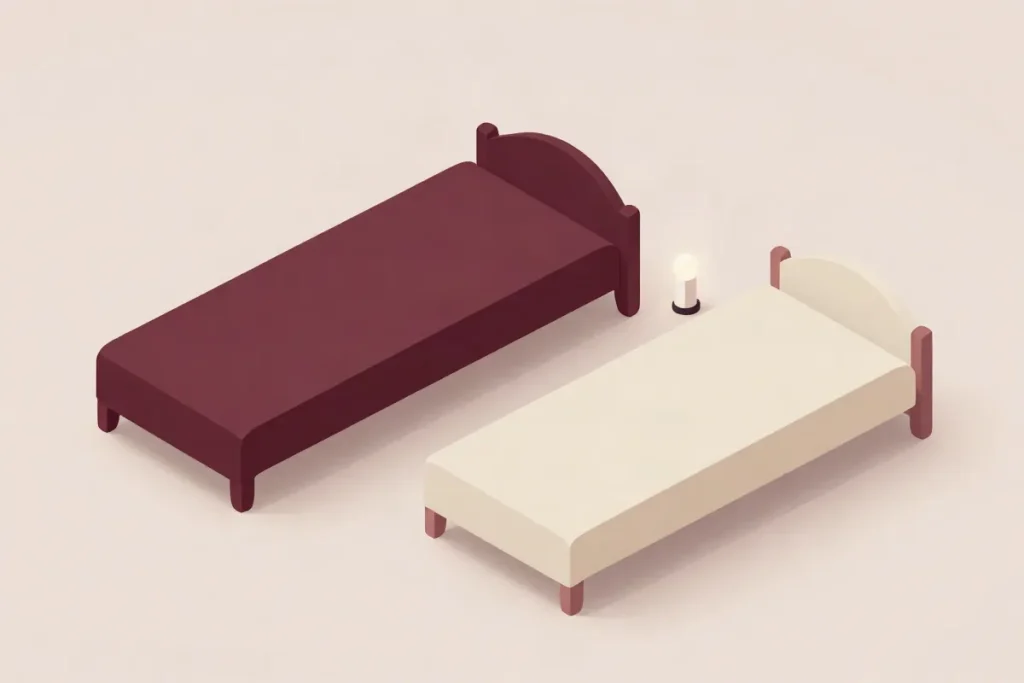
A newborn is safer sleeping in their own crib near their parents than in the same bed with them. This keeps the baby close while giving them a separate place to sleep.
Sharing a bed may seem convenient for nighttime feeds, but in an adult bed an infant could end up under a blanket or pressed against the mattress. This article looks at where to put a baby’s crib and how to arrange sleep nearby.
| Criterion | Separate crib or bassinet nearby | Shared adult bed |
|---|---|---|
| Sleep surface | Separate from the adult’s | Shared with the parents |
| Access at night | The baby is nearby and easy to reach | The baby is close by in the bed |
| Risks to the infant | A separate space helps keep adult pillows and blankets away | A soft mattress, pillows, and blankets can cause suffocation |
| Who it suits, based on the criteria | Those who value closeness and a separate sleep surface | Convenience for parents does not remove the risk to the infant |
- 20 ml the capacity of a newborn’s stomach at one time
- about 30 percent of milk that, according to Olivia Hinge, remains in the breast
How is a separate crib near the parents different from a shared bed?
A separate crib or bassinet beside the parents’ bed gives the infant their own place to sleep while letting an adult reach them quickly; in a shared bed, the baby sleeps on the same surface as the parents.
- Crib or bedside bassinet. The baby lies separately, and an adult can easily reach them at night. There are no adult pillows or blankets in the baby’s sleeping space.
- Adult bed. A soft mattress, pillows, blankets, and other items near the infant can create a risk of suffocation. Here, the baby shares a sleep surface with adults.
The main difference is not the distance from the parents, but where exactly the infant sleeps. A crib beside the bed keeps the baby close without putting them on the adult mattress.
If it is important to reach the baby quickly at night, a bedside bassinet or crib combines closeness with a separate sleep surface. Make sure the baby’s sleeping space is free of adult pillows, blankets, and other items.
How do nighttime feeds affect the choice of where the baby sleeps?
Frequent nighttime feeds make quick access to a newborn important, but they do not in themselves make a shared bed safer: a separate crib or bassinet beside the parents’ bed makes it easy to pick up the baby without putting them on the adult mattress.
According to UNICEF, a newborn’s stomach can hold just 20 ml of liquid at a time. That is why a baby may wake frequently to eat or drink, and these wake-ups become part of nighttime care.
Night feeds and breast milk
UNICEF quotes Olivia Hinge, an internationally certified lactation consultant and midwife from the UK: “There will always be about 30 percent of the milk left in the breast.” This is worth bearing in mind if the breast feels empty after a feed.
Ball notes: “Actually, it’s more important to do this at night because more prolactin is produced at night.” Night feeds can support breastfeeding, but the choice of sleep space should be considered separately from the frequency of feeds.
- Crib or bassinet nearby: You can quickly pick up the baby for a feed, then return them to a separate sleep surface.
- Shared bed: A soft mattress, pillows, blankets, and other items can create a risk of suffocation.
If you choose a separate crib, place it beside the parents’ bed: nighttime care will still be within easy reach, and the baby will not be sleeping on the adult mattress.
When is a shared bed unsuitable for an infant’s nighttime sleep?
A shared bed is unsuitable for an infant’s nighttime sleep if it contains a soft mattress, pillows, blankets, or other items that could obstruct the baby’s airway.
It is difficult to create a separate safe space for an infant in an adult bed while soft items remain nearby. If you cannot remove them and provide a safe sleep surface, place a separate crib or bassinet beside the parents’ bed.
Convenience for parents does not remove the risk
A shared bed may seem more convenient: the baby is close, and parents may sometimes find it easier to rest. But this convenience does not eliminate the risk of suffocation for the infant. When deciding where the baby will sleep, first consider whether you can make their sleep surface safe.
- Adult bed: Unsuitable if it still has a soft mattress, pillows, blankets, or other items that could endanger the infant’s breathing.
- Crib or bassinet nearby: Choose this option if you cannot remove the dangerous items and provide the baby with a safe space in the shared bed.
How the choice of sleep space affects parents’ rest and family relationships depends on each family’s circumstances. There is no one-size-fits-all answer; first check whether you can provide a safe place for the infant to sleep at night.
How can you agree on nighttime care and reconsider your decision?
Agree on nighttime care in advance: decide who will find it easier to get up for the newborn and where their separate crib or bassinet will go.
Compare the options using two criteria: surface safety and ease of access at night:
- A separate crib or bassinet beside the parents’ bed: The baby has their own sleeping space, and an adult can easily reach them.
- Adult bed: A soft mattress, pillows, blankets, and other items near the infant can create a risk of suffocation.
Who gets up for the baby depends on the family’s routine. Discuss it together and check that you can reach the crib at night without having to move around furniture or shift it each time.
When to revisit the decision
If having the crib nearby makes nighttime care easier but does not work for the family for other reasons, discuss its location or another option for a separate sleep space. You can revisit the decision once you have a clearer sense of what nights with the baby are like.
Don’t turn the choice into an argument about the one right way to parent. First identify a safe place for the infant, then divide nighttime responsibilities; before bed, check that there are no pillows, blankets, or other items in the baby’s crib.
Frequently asked questions
Where is it safer for a newborn to sleep?
Can you put a crib beside the parents’ bed?
Does sharing a bed help parents rest better?
Do you need to choose one option and never change it?
Key takeaways
- A crib or bassinet nearby combines a separate sleep surface with quick access to the infant.
- A soft mattress, pillows, and blankets make an adult bed dangerous for a newborn.
- A newborn’s stomach holds just 20 ml of liquid at a time, so nighttime feeds may be frequent.
- Convenience for parents does not replace checking that the sleep space is safe.
Sources
- surkovainfo.ru — “Co-sleeping and having your own crib. Part One. In collaboration with baby-sleep.ru”
- pravonachudo.ru — “Should you take your baby into your bed? Safety rules, benefits, and risks of co-sleeping — Right to a Miracle, a charity helping premature babies”
- pp3.dkmc-chita.ru — “Co-sleeping: a necessity or a trend?”
- maam.family — “Where should a baby sleep: a crib or a bassinet?”
- vk.ru — “FROM CO-SLEEPING TO THEIR OWN CRIB — Friends”