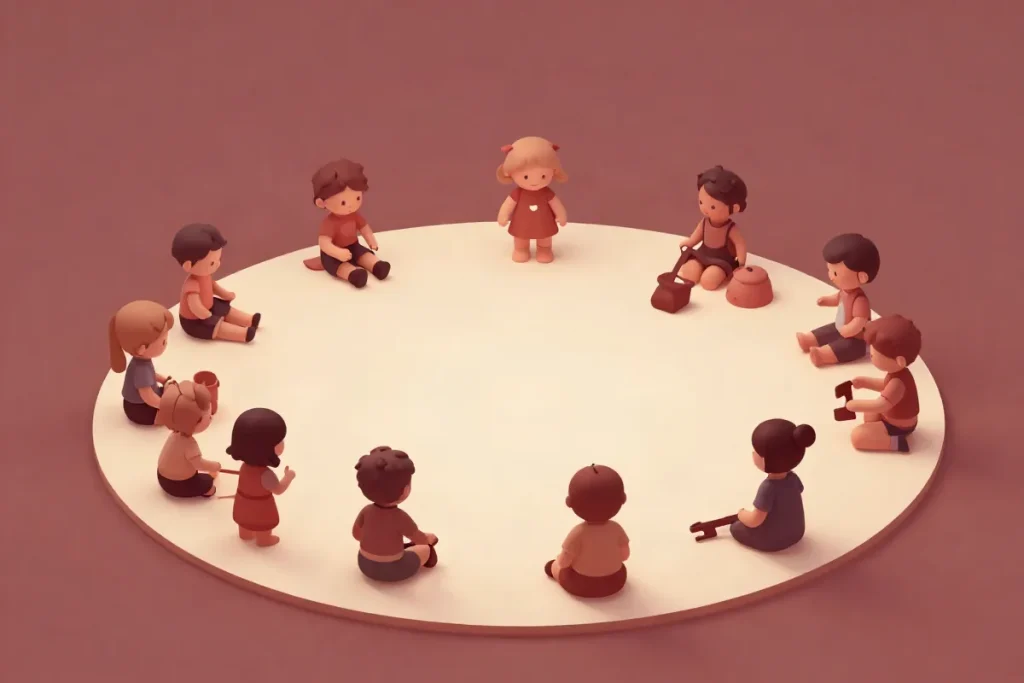
Why Do Children Aged 2–3 Often Fight Over Toys?
Conflicts among toddlers aged two to three over toys are very common and natural. At this age, children are just beginning to learn how to share and use things together. Their empathy and negotiation skills are still very limited, while their desire to possess a toy is very strong. According to observations by educators and psychologists, about 60% of conflicts in groups of toddlers are linked specifically to attempts to get or hold onto a toy.
An important factor is also the limited availability of toys in the child’s environment: if there is no alternative, the child is more likely to argue. Additionally, toddlers cannot yet express their feelings verbally, which leads to outbursts of anger and tears.
Main Causes of Conflicts Among Children Aged 2–3
Psychological and Social Factors
At the age of 2–3, children face the following difficulties that provoke conflicts:
- Inability to share — children still don’t understand that a toy can be given temporarily and then returned.
- Lack of negotiation skills — toddlers don’t know how to make agreements or find compromises.
- Egocentrism — the child sees the toy as their own property and perceives attempts to take it away as a threat.
- Low self-control — tantrums and outbursts of anger occur more often due to weak emotional regulation.
External Circumstances
Conflicts are also influenced by external factors:
- Lack of toys — when favorite items are scarce, the likelihood of conflict increases.
- Absence of adult supervision — without timely intervention, quarrels quickly escalate into fights.
- Negative example — if parents argue frequently, children adopt that behavior pattern.
How to Improve the Situation: Conflict Prevention Methods
Preventing quarrels begins with creating conditions for cooperative play and teaching children communication skills. The main methods include:
Developing Sharing and Turn-Taking Skills
- Explain to children that toys can belong to different kids in turns.
- Use a timer — for example, a toy can be held for 5 minutes, then passed to another child.
- Teaching through the example of parents and caregivers.
Encouraging Cooperative Play
Playing together helps develop empathy and cooperation skills. Play sets designed for multiple children are ideal for this.
The Role of Adults During Conflicts
Adults should carefully observe play and intervene at early stages of conflict, guiding children toward joint solutions.
Play Techniques for Preventing and Resolving Conflicts
Using Specific Strategies
- “My Turn” Game — teaches waiting for one’s turn and respecting others’ rights.
- Role Play — the child takes on another’s role to understand their feelings.
- Collaborative Creation — building a construction set or molding together fosters a sense of unity.
Toys and Games That Promote Friendship
The choice of toys affects the level of conflict. Here are some examples:
| Name | Manufacturer | Price (₽) | Features | Age |
|---|---|---|---|---|
| «Happy Farm» Set | PlaySmart | 1500 | Animal figures designed for interactive play | 2–4 years |
| «Friends» Construction Set | BrightKids | 2200 | Large pieces encouraging cooperative building | 2–5 years |
| «World Around Us» Puzzles | EduPuzzle | 1300 | Collaborative solving, developing logic and patience | 3+ years |
The Role of Parents and Caregivers in Preventing Conflicts
Parents and caregivers play a key role in developing peaceful communication skills in toddlers. Their responsibilities include:
- Observing play and intervening promptly.
- Explaining the rules of communication and shared toy use.
- Modeling positive interaction behavior.
- Praising successful conflict resolution.
Adults should understand that quarrels are a natural part of socialization and it’s important not to suppress the child but to teach them how to manage their emotions.
Statistics and Key Indicators
- 60% — proportion of conflicts among children aged 2–3 related to toys
- 5 minutes — recommended toy possession time using the «My Turn» technique
- ₽1300–2200 — price range of play sets for cooperative play
- 2–3 years — age when foundations of cooperative play skills are laid
Frequently Asked Questions
How can I teach my child to share toys?
What should I do if children constantly fight over the same toy?
When should adults intervene in conflicts between toddlers?
Which toys are best for developing cooperative play?
Key Takeaways
- Toy-related conflicts among children aged 2–3 are a natural stage in developing communication skills.
- Main causes include limited sharing skills, emotional expression difficulties, and toy scarcity.
- Prevention involves teaching sharing, using timers, and encouraging cooperative play.
- Adults should actively observe and support socialization through play.
- Choosing appropriate toys and play methods significantly reduces conflicts.
In conclusion, understanding the psychological traits of toddlers and applying play techniques help create a friendly atmosphere during group play. This not only reduces conflicts but also lays the foundation for successful communication and cooperation in the future.
Sources
- Educational Social Network — “Causes of Conflicts Among Preschoolers | Consultation (Younger Group)”
- Rozmova.me — “Causes of Family Conflicts and Ways to Prevent Them”
- chastnaya-psihiatricheskaya-klinika-stacionar.ru — “Conflicts Between Parents and Children: Causes and Conflict Resolution”
- psyholic.ru — “Why Children Leave the Parental Home: Main Causes and Ways to Prevent It — Psyholic”