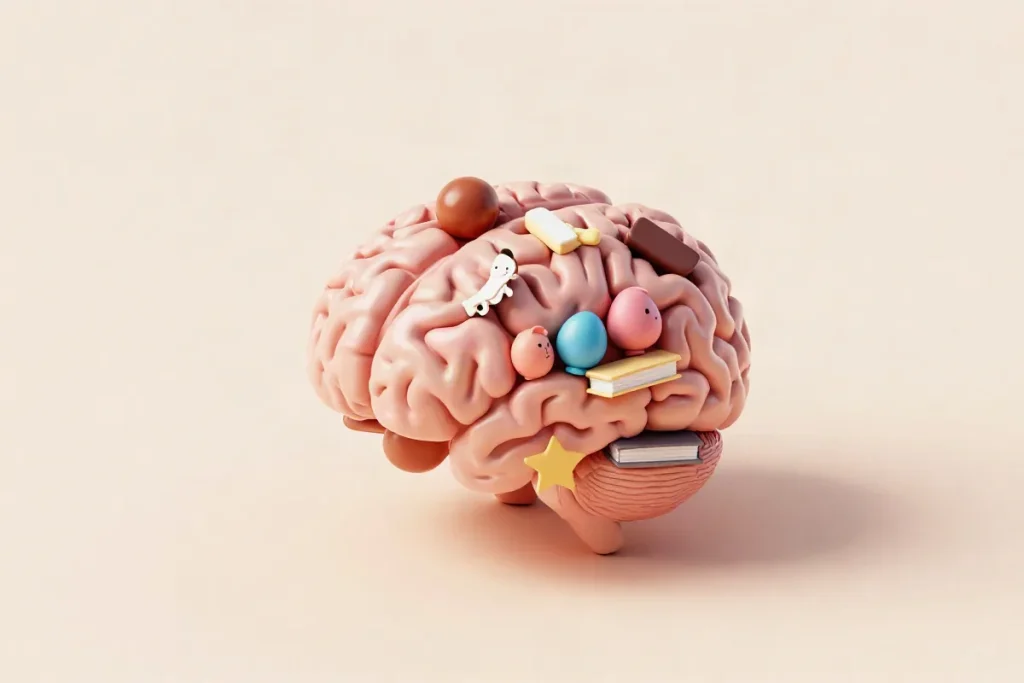
The development of a child’s brain in the first five years is an exciting and dynamic process that lays the foundation for their future life. It is during this period that key neural connections responsible for learning, memory, and emotional perception are formed. Parents play an important role in this process by providing their little ones with stimuli for active mental and emotional growth.
Throughout the first five years of life, a child’s brain develops at an astonishing rate. Scientific studies show that about 90% of all neural connections are formed during this time, making it crucial for further development. Understanding how a child’s brain develops in the first five years will help parents create an optimal environment for learning and creativity, as well as support their child’s emotional health at every stage of growth.
| Method | Effect | Example Product |
|---|---|---|
| Reading | Increases vocabulary by 50% | «Bedtime Stories» books |
| Music | Improves IQ by 15% | Classical music albums |
| Games | Develop social skills by 30% | LEGO building sets |
- 1000 trillion Number of synapses by age 5
- 25% Cognitive ability increase with stimulation
- 400 ₽ Price per 1 kg of salmon for omega-3
Stages of Brain Development
Early Activity
In the first three years of life, a child’s brain develops especially rapidly, reaching 80% of the volume of an adult brain. During this period, fundamental changes occur that lay the groundwork for future learning and development. For example, by age two, children experience significant growth in neural connections, which supports the formation of basic skills necessary for full communication and understanding of the surrounding world.
Peak Synaptic Activity
By age five, a child’s brain has about 1000 trillion synapses, which is twice the number found in adults. A peak of activity is especially noticeable in the language area around ages 2 to 3, when children actively acquire the basics of speech. This phase is critically important for developing communication skills. Studies show that during this period, children can learn up to 10 new words per day, highlighting the importance of interaction and engagement with others.
- Ages 0-3 years: 80% of adult brain volume.
- Number of synapses by age 5: 1000 trillion.
- Peak language activity: 2-3 years, up to 10 new words daily.
Environmental Influence on Development
Stimulation and Cognitive Abilities
Research conducted by Harvard University shows that creating a highly stimulating environment can increase a child’s cognitive abilities by 25%. This underscores the importance of a diverse and rich environment for early development. Children who regularly listen to music score 15% higher on intelligence tests compared to peers without such exposure. Musical development can include playing instruments or listening to classical music, both of which positively impact overall brain development.
The Role of Educational Toys
One effective way to enrich the environment is through educational toys. For example, LEGO building sets, priced from 1200 ₽, promote the development of logical thinking and fine motor skills. Creative kits also play an important role, allowing children to develop creativity and imagination. These toys not only keep children engaged but also help them acquire new skills.
- LEGO building sets — from 1200 ₽, develop logic and motor skills.
- Creative kits — from 800 ₽, stimulate creativity.
- Musical instruments — from 1500 ₽, improve intelligence test results.
Nutrition and Brain Development
Proper nutrition plays a key role in brain development during a child’s early years. Essential fatty acids, especially omega-3, have a significant impact on cognitive functions. Fish such as salmon are an excellent source of these beneficial nutrients. As of 2026, the price for 1 kilogram of salmon is around 400 ₽, making it an accessible product to include in children’s diets. Regular consumption of omega-3 can improve memory and attention in young children.
Vitamins and Minerals
Vitamin D also plays an important role in brain development, and its deficiency can lead to a 20% decrease in cognitive functions. Sunlight is the main source of this vitamin; however, in conditions of limited sun exposure, supplements may become necessary. Experts recommend that children consume at least 250 ml of milk per day to provide essential micronutrients for optimal growth and development. Milk contains calcium and protein, both critical for brain formation.
- Omega-3: salmon, 400 ₽ per 1 kg
- Vitamin D: 20% decrease in cognitive function if deficient
- Milk: 250 ml daily for optimal development
Social Interaction
Social interaction plays a key role in brain development during a child’s early years. Studies show that children who actively interact with peers demonstrate 30% better communication skills by age five. This is because socializing and playing help form important neural connections that contribute to cognitive and emotional development.
The Importance of Communication
Regular interaction with other children aids not only in speech development but also in understanding emotions. According to the National Institutes of Health, participation in group activities can improve children’s emotional development by 40%. This is especially important for social adaptation and building self-confidence.
Group Activities
Team games such as soccer or dance classes support the development of social skills and self-esteem. For example, dance studio classes can cost between 2,000 and 4,500 ₽ per month, depending on the region and level of instruction. Team sports like soccer not only promote physical activity but also teach children how to work as part of a team, which is an important aspect of their social development.
- Dance studio: 2,000 to 4,500 ₽ per month
- Soccer club: 1,500 to 3,000 ₽ per month
- Children’s clubs: sessions 2-3 times a week
The Role of Parents in Brain Development
Reading and Its Impact
Reading to children under five has a significant impact on brain development and language skills. Statistics show that regular reading can increase a child’s vocabulary by 50%. This is especially important in early childhood when the brain is actively forming neural connections. Programs like «Reading Together,» conducted in kindergartens, help parents systematically develop their children’s speech by offering guidance on book selection and reading methods. For example, children’s books from the «Umka» series cost between 300 and 600 ₽ per copy and are ideal for shared reading.
Active Involvement
Active parental involvement in children’s learning also plays a key role in their intellectual development. Studies show that parental engagement can increase children’s academic performance by 25%. This can be achieved through play-based learning, discussing what has been read, and joint projects. Important aspects include:
- Regular sessions — at least 3-4 times a week.
- Choosing educational games, such as «Erudit,» costing 800 to 1200 ₽.
- Attending developmental courses, such as early learning courses from «Knowledge Farm,» starting at 2000 ₽ per month.
By supporting active involvement in learning, parents help children not only develop intellect but also build confidence in their abilities.
Frequently Asked Questions
What is the best nutrition for brain development?
When does speech development begin in children?
How does music affect a child’s brain?
Key Takeaways
- A child’s brain reaches 80% of adult volume by age 3.
- Social interactions improve communication skills by 30%.
- Reading to children increases vocabulary by 50%.