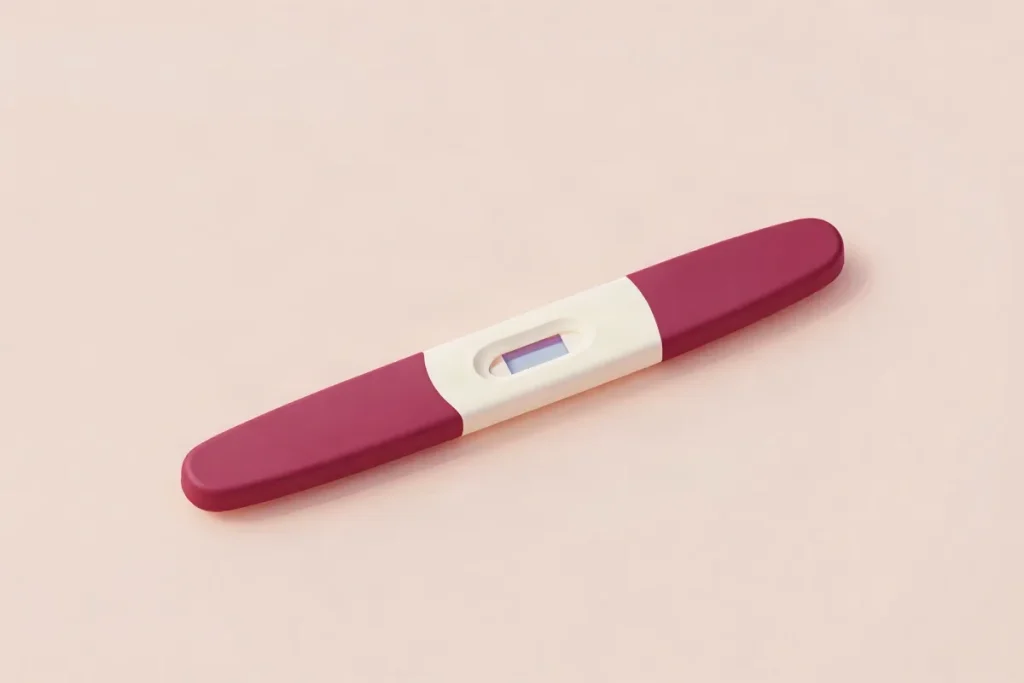
You can’t tell whether you’re pregnant from how you feel alone: a test can confirm pregnancy, and if you’re unsure about the result, it’s worth discussing it with a doctor.
A missed period, nausea, and breast tenderness can be early signs of pregnancy, but they can also have other causes. This article explains what to look out for, when to take a test, and what to do if the result is unclear.
| Method | What it checks | When it’s useful | Limitation |
|---|---|---|---|
| Home test | hCG in urine | For an initial check at home | If you test too early, the result may not provide a clear answer |
| Blood test | hCG in blood | To check for pregnancy earlier | You need to visit a healthcare provider |
| Ultrasound | Presence of the gestational sac and its development | For a doctor to assess the pregnancy | An ultrasound performed too early may not provide useful information |
| Basal body temperature | Temperature changes during the cycle | As an additional observation | Does not confirm pregnancy on its own |
- 15–25% of women experience light spotting 6–10 days after ovulation
- 0,3–0,5 °C typical rise in basal body temperature after ovulation
- more than 16–18 days in a row period for which basal body temperature may remain elevated after conception
- > 38 °C temperature at which you should seek urgent medical attention in early pregnancy
What early signs may appear before a missed period?
Changes in taste, increased sensitivity to smells, and nausea may occur before a missed period, but none of these signs on its own confirms pregnancy.
Not everyone experiences these symptoms, and they can resemble PMS. Some 15–25% of women experience light spotting 6–10 days after ovulation, which is associated with the future embryo attaching to the uterine wall. Spotting alone cannot tell you whether you’re pregnant.
A missed period is a reason to take a test, but it does not confirm pregnancy on its own. If you test too early, the result may be negative, so if your period is late, it’s worth testing again.
When will a home test show that you’re pregnant?
You can take a pharmacy pregnancy test when your period is late: it detects human chorionic gonadotropin, or hCG, in your urine.
Different tests may vary in how they’re used and how long it takes to get a result, so follow the instructions for the specific test you choose.
On a paper rapid test, the control line indicates a positive result, while the test line shows that the test has worked.
If the test is negative but your period hasn’t started or your symptoms persist, take another test later or see a doctor.
How is an hCG blood test different from a home test?
An hCG blood test and a home test detect the same hormone, but a blood test is more sensitive and can detect pregnancy earlier.
- Home test: detects hCG in urine and can be done at home.
- Blood test: measures hCG in blood; you need to visit a healthcare provider for this test.
An early negative result on a home test does not always rule out pregnancy: hormone levels may still be too low to detect in urine.
If you need to clarify an early result or the test result doesn’t match how you feel, talk to your doctor about an hCG blood test.
Can basal body temperature confirm pregnancy?
Basal body temperature can only suggest pregnancy indirectly: a single reading cannot confirm conception because temperature changes throughout the cycle.
Before ovulation, basal body temperature is usually 36,3–36,7 °C. After ovulation, it typically rises by 0,3–0,5 °C, to 36,9–37,4 °C; for some people, it reaches 37,5 °C without indicating a health problem.
After conception, temperature may remain elevated for more than 16–18 days in a row. If pregnancy has not occurred, it usually drops before menstruation. However, even a prolonged rise does not replace a test: use a home test or see a doctor to check for pregnancy.
When can an ultrasound and a gynecologist’s appointment clarify the result?
An ultrasound and a visit to a gynecologist can help clarify the result, but an ultrasound performed too early may not provide useful information: the gestational sac may not yet be visible.
An ultrasound can show the gestational sac and assess its development. So don’t choose the date of the scan based only on the presumed date of conception: it’s best to discuss the timing and need for an ultrasound with your doctor.
A gynecologist will consider your home test or hCG blood test result alongside how you’re feeling and suggest what to do next. If the pregnancy is confirmed, you can discuss prenatal care and preparations for pregnancy at your appointment.
Why can symptoms and a negative test be misleading?
Symptoms do not confirm pregnancy, and a negative test does not rule it out if you took it too early: early signs can resemble PMS.
Nausea, changes in taste, and a missed period can occur during pregnancy, but on their own they don’t show what’s causing them. Early changes vary from one woman to another; some don’t notice any at all. So not having nausea does not prove that you aren’t pregnant.
A home test detects human chorionic gonadotropin (hCG) in urine. If the result is negative but your period hasn’t started, take another test later or see a gynecologist: an hCG blood test is more sensitive and can detect pregnancy earlier.
Basal body temperature and a single unusual symptom cannot provide a reliable answer. Don’t use home remedies to check for pregnancy: if your period is late, rely on a test and a medical assessment.
When do you need urgent medical care?
Severe pain on one side, heavy bleeding, or a temperature of > 38 °C in early pregnancy are reasons to seek urgent medical attention.
Don’t wait to take another test if you experience any one of these signs: with symptoms like these, medical assessment is more important than checking the result again.
If you have no worrying symptoms
If your test is positive and you have no severe pain, heavy bleeding, or high fever, schedule an appointment with a gynecologist. The doctor will assess your health and advise you on what to do next.
Sources
- m.5-tv.ru — “How to Tell You’re Pregnant: Signs, Tests, and Methods”
- Bangkok Pattaya Hospital — “Early Pregnancy Symptoms: First Signs and Hormonal Changes”
- My Clinic — “The First Signs of Pregnancy in the Early Stages”
- t-j.ru — “I’m Pregnant. What Should I Do? A Guide for Expectant Mothers”
- gemotest.ru — “The First Week of Pregnancy After Conception: Early Signs of Pregnancy”