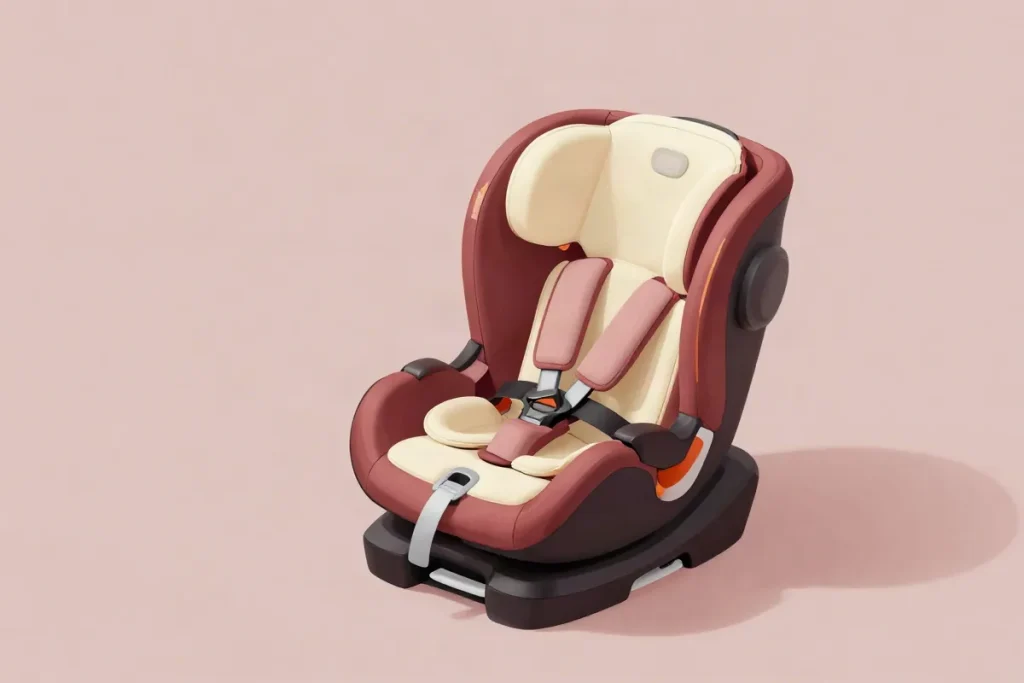
Change a car seat when your child reaches the maximum height or weight specified for that model. Age alone isn’t enough: check the seat’s label and how your child fits in it.
Limits vary between models. If your child’s head is close to the top edge of the backrest, the harness can’t be adjusted as instructed, or your child is over the permitted weight, it’s time to choose the next seat—one that fits both their height and weight.
| Group | Age guideline | Weight | Height |
|---|---|---|---|
| 0+ | Newborns | Up to 10 kg | Not specified |
| 1 | A separate stage as the child grows | Check the model’s label | Check the model’s label |
| 2 | Three to seven years | 15–25 kg | Not specified |
| 1/2/3 | 9 months to 12 years | 9–36 kg | 80–145 cm |
- up to 10 kg stated weight limit for category 0+
- 15–25 kg weight range for group 2
- 80–145 cm height range for a group 1/2/3 seat
How do groups 0+, 1 and 2–3 differ?
Groups 0+, 1 and 2–3 differ in their weight limits and the child’s stage of growth, while a universal 1/2/3 seat covers several stages at once.
- Group 0+. These seats are chosen for newborns; descriptions of the category specify a limit of up to 10 kg.
- Group 1. This is a separate stage in choosing a seat as your child grows. Age alone isn’t enough: weight and height should also be considered.
- Group 2. This group is specified for children aged three to seven and weighing 15 to 25 kg.
- Universal group 1/2/3. These seats are designed for children from 9 months to 12 years old, weighing 9–36 kg and measuring 80–145 cm tall.
What to check when installing the seat
The group label helps narrow down your choices, but before buying, check the seat’s limits against your child’s height and weight, and make sure the model is compatible with your car.
If the seat comes with a Top Tether strap, use it if your car has an anchor point. A support leg is an alternative to Top Tether, especially for rear-facing seats.
When has your child outgrown their current car seat?
Your child has outgrown their car seat if their actual height or weight exceeds the range specified on that particular model’s label.
Check both measurements: being within the weight limit isn’t enough if your child’s height already exceeds the seat’s limit. Limits can vary between models, so follow the label rather than relying on the group name alone.
- Group 1/2/3 model: check the full range—ages 9 months to 12 years, weight 9–36 kg and height 80–145 cm. Your child must be within the stated height and weight limits.
- Moving up to another group: base your decision on height and weight. Age alone doesn’t determine whether it’s time to switch models.
- Exceeding the limits: if your child has outgrown even one of the limits on the label, choose the next seat according to its own limits.
Check how tightly the harness is fastened
Even a seat that’s the right size needs to be adjusted correctly. To check the harness tension, try pinching the strap at your child’s collarbone between your fingers: if you can pinch a fold of fabric, tighten the harness.
Then check your child’s height and weight against the label on the model you’ve chosen: those limits determine whether the seat is suitable.
How do you check the label and compatibility with your car?
You can check a car seat’s label and compatibility by looking at its group designation, stated height or weight limits, and the installation method specified for that particular seat and car.
- Seat label: find the group designation and the weight or height limits. Compare them with your child’s measurements: the seat should fit them now, not just in the future.
- Seat attachments: check which installation method the manufacturer specifies and whether your car has the corresponding anchor points.
- Standard requirements: the description of ECE 129 on 5koleso.ru states that the seat is secured in the car exclusively using Isofix. Still, check the instructions and label for the specific seat.
Check the installation in your car
Don’t assume a seat is compatible just because of its model name or because it has Isofix. Before buying, install the seat in your car and make sure it can be secured using the method specified for it.
If the seat’s attachments don’t match your car’s, don’t try to substitute another installation method. Check the instructions for both the seat and the car; if you’re unsure, ask the retailer to demonstrate the installation in your vehicle.
How do you check the attachments and harness tension?
Check the car seat’s installation instructions: use Top Tether if the strap is included and your car has an anchor point, then make sure the harness fits snugly against your child.
What to check after installation
- Top Tether. Attach the strap to the car’s anchor point if both are provided for your seat and vehicle.
- Support leg. In some models, this is an alternative to Top Tether, including for rear-facing seats. Check the instructions to see which attachment is suitable for your model.
- Internal harness tension. Once the seat is secured, place your child in it and check the strap at their collarbone. If you can pinch a fold of fabric between your fingers, tighten the harness.
Check your child’s fit and the car seat’s attachments every time you install the seat in the car. If you remove or reposition the seat, check its installation, the position of the support leg or Top Tether, and the harness tension again.
What limits and mistakes should you keep in mind?
When choosing a car seat, consider more than just the age group: check your child’s height and weight, how they fit in the seat, and whether it can be installed correctly in your car.
- Universal model: a wide height and weight range doesn’t guarantee that a seat will fit your particular child. Check their height and weight against the label, then check the fit.
- Group 2 seat: it is designed for children weighing 15 to 25 kg. Don’t apply this range to seats in other groups; their limits may differ.
- Child’s age: don’t use age as your only criterion. Consider height and weight as well.
- Installation in the car: a model that fits the label’s specifications won’t be suitable if it can’t be installed correctly in your car. Before buying, check that you can secure the seat using the specified method.
Fit matters too: your child must fit in the seat while staying within its height and weight limits. If the label matches but you can’t install the seat correctly in your car, you need a different model.
Frequently asked questions
Can you choose a car seat based on age alone?
What is the maximum height for a group 1/2/3 seat?
What should you check if the seat uses Top Tether?
How can you tell if the seat harness is too loose?
Sources
- cybex-rus.ru — “How to choose a child car seat?”
- NaDitok — “How to choose a car seat for a child by age and weight”
- Russia — “Infant car seat: how to choose a safe system? ← Baby’s First-Aid Kit”
- vunderkindplus.ru — “How to choose a child car seat? — Wunderkind Novorossiysk”
- 7d.by — “All about choosing a car seat — 7 Detok”