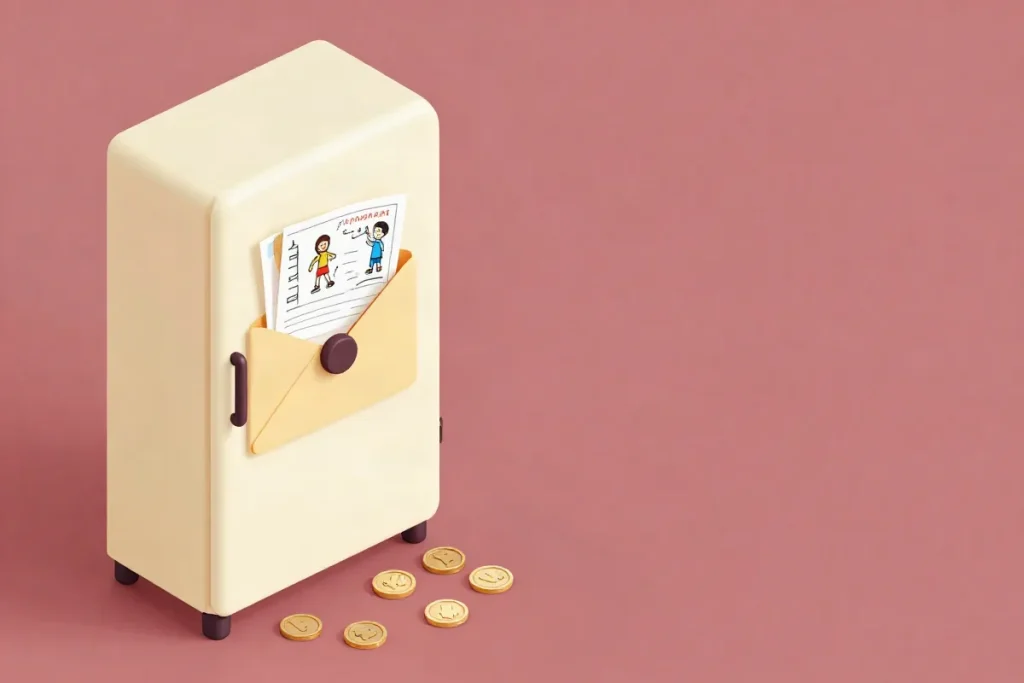
You can give a preschooler a small amount of pocket money once they start counting and understand that a purchase costs a certain amount.
First purchases help children learn to choose and wait until they have saved enough. Start with simple rules: how much money to give, what they can buy, and whether they need to discuss the purchase first. Pocket money for a preschooler isn’t payment for good behavior; it’s a chance to practice making choices safely.
| Format | What it’s suitable for | What to consider |
|---|---|---|
| Cash | A first purchase and checking the change | An adult can stay nearby |
| Spending envelope | Keeping a small amount for everyday spending | The child can see how much money is available |
| Separate savings envelope | Saving money for a chosen goal | You can illustrate the goal with a picture |
| Bank card | A later stage in managing money independently | Terms vary by bank; a card isn’t necessary for a first purchase |
Who’s ready to make a first purchase independently?
A child is ready for a first independent purchase if they understand that they need to pay for the item and collect the change. Age alone doesn’t determine readiness.
Under the Russian Civil Code, children aged six and older can make small everyday transactions. For example, they can buy bread at a bakery. This right doesn’t mean you should send a child to the store alone straight away: first, see how they manage a purchase with an adult nearby.
Start by shopping together
It’s easier to buy a familiar item together: the child can ask the shop assistant for bread, hand over the money, and take the change while an adult stays nearby. This lets you see whether they understand the steps and can hold on to the money until it’s time to pay.
- Knows what to do with the money. The child gives the shop assistant the amount due and collects the change.
- Can talk to the shop assistant. If the child gets flustered, the adult can help with the conversation.
- Doesn’t lose the money. If the child can’t hold on to it until the purchase, the adult stays nearby.
Move on to an unaccompanied purchase only once the child can confidently repeat these steps in a familiar situation. If they get confused, keep going to the bakery together and let them handle the next step themselves.
How can you arrange a first purchase without involving the family budget?
Make the first purchase a short practice run: choose one small item with a clear price, such as bread at a bakery, and talk through what to do beforehand.
Don’t turn the purchase into a conversation about all the family’s expenses. It’s easier for a child to focus on one familiar step—buying bread—than to try to understand the family budget at the same time.
Before you go into the bakery, agree on three things: exactly what the child will buy, where they’ll wait for you, and who they’ll give the change to. This gives them a clear plan while allowing you to stay close by.
At the counter, invite the child to hand the money to the shop assistant themselves. After the purchase, check together that they got the bread and the change; if they get flustered, calmly guide them through the next step.
Stay nearby the first few times and step in only if needed. Here, independence doesn’t mean shopping without an adult; it means following a familiar sequence with support: choose the bread, pay, check the item, and hand over the change.
How can you separate spending money from savings?
To separate spending money from savings, start with a small amount and explain to the child that they can decide how to spend it, while adults will continue to buy the things they need.
This makes it easier for a child to practice making their own choices without mistaking pocket money for a budget for clothes, food, or other necessities. Choose an amount that works for your family: an example involving an older child doesn’t set a standard for a preschooler.
An envelope and a visible goal
- An envelope for spending money — put in an amount the child can spend on purchases they choose.
- A separate savings envelope — put money aside for a specific item they want. Keeping the money in separate places helps them see that it has different purposes.
- A picture of the goal — suggest that they draw the item they want and put the picture somewhere visible. For example, if the child is saving for a toy, the picture can remind them what they’re saving for.
Here’s an illustrative example from a German source: a 12-year-old receives €30 a month and decides to save €10 for headphones. This illustrates how to divide money; it isn’t an amount or rule for a preschooler. You can start with a small amount for your child and decide together what portion to keep for everyday purchases and what portion to put toward the goal in the picture.
How does the Russian rule differ from Germany’s §110 BGB?
Russian law allows children to make small transactions from the age of six, while Germany’s §110 BGB permits a child aged seven or older to make a purchase only under certain conditions. Neither age, by itself, means a preschooler is ready to buy anything without an adult.
In Russia, children aged six and older can make small transactions. That doesn’t remove the need to consider whether the child understands what they’re buying and can handle the payment. For a first purchase, choose a familiar store, decide on the item in advance, and stay nearby.
What §110 BGB requires
§110 BGB, known as the “pocket money provision,” applies in Germany under certain conditions: a child aged seven or older must pay for the purchase in full using money provided for that purpose or given for unrestricted use with parental consent. The rule applies in Germany, so it shouldn’t be used as a guide to purchases in Russia.
Money for such a purchase can be kept in a checking account, while savings are stored separately. This helps keep money for everyday spending apart from money the child is setting aside.
- In Russia: children aged six and older can make small transactions; readiness for a particular purchase depends on more than age.
- In Germany: §110 BGB requires a child aged seven or older to pay in full with eligible funds and parental consent.
- For a first purchase: choose a familiar store and a specific item, and stay nearby.
When isn’t a card right for a first experience?
Cash or a card?
For a preschooler’s first purchase, cash is usually a better choice: the child can see how much they paid and how much they got back. You can count the change together and discuss whether it matches the price of the purchase.
- Cash. Makes the link between the item’s price, the amount paid, and the change easy to see.
- An envelope. Lets you keep money for everyday purchases separate from savings, without using a banking app.
- A card. It isn’t necessary for a first experience; what matters first is understanding how the child handles money and makes a purchase.
DKB has a specific identification requirement: DKB accepts a copy of a birth certificate to identify children under 16 who don’t have an identity document. This is a DKB policy, but it doesn’t mean a preschooler needs a bank card.
Don’t give a child a card just to make them feel grown-up. Before an independent purchase, check whether they can name the amount, explain what they’re buying, and say what to do if they make a mistake—for example, count the change incorrectly or choose the wrong item. If they can’t do that yet, it’s easier to make the first purchase with cash and talk it through together.
When doesn’t pocket money solve the problem?
Pocket money doesn’t help if it becomes a reward for good behavior or a punishment for a mistake: in that case, it’s harder for a child to learn to choose how to spend it.
After an unsuccessful purchase, don’t automatically replace the money spent. First, calmly discuss what didn’t go as expected: perhaps the item wasn’t what the child thought it was, or they spent all the money at once. Then think about what they could do differently in a similar situation next time.
There’s no need to ask for an account of every little thing, but it’s best to explain the basic responsibilities in advance. The child takes care of the money, pays for the purchase they choose, and asks an adult for help if the change or the item doesn’t match what you agreed on.
What to consider before the first purchase
There’s no one-size-fits-all age or format for a purchase: the decision depends on whether the child can manage the specific steps. You can start with a purchase supervised by an adult if the child still finds it difficult to hand over the money or check the change on their own.
- If the child can name the item they’ve chosen and pay for it, let them handle the purchase themselves with an adult nearby.
- If the change or the contents of the purchase make them unsure, agree that they’ll call an adult right away.
- If the child can’t manage these steps yet, you can put off the purchase and try again later.
Before you leave, decide what exactly the child will buy and when they should ask for help.
Frequently asked questions
Can you give a preschooler pocket money?
Should you let a child go to the store alone?
What’s better for a first purchase—cash or a card?
What should you do if your child spends money unwisely?
Can Germany’s §110 BGB be applied in Russia?
Key takeaways
- For a first purchase, choose a familiar item, such as bread at a bakery.
- Stay with the child at first, and let them pay for the item and check the change themselves.
- Use separate envelopes to divide money for everyday purchases and savings.
- §110 BGB applies in Germany; the minimum age for small transactions in Russia is six.
Sources
- fincult.info — “How to Give Children Pocket Money: Tips for Parents”
- finicschool.ru — “Pocket Money. How Much? When? Why?”
- GIVE OR NOT GIVE — “POCKET MONEY FOR CHILDREN”
- xn--80ajjifdqt0evb7a.xn--p1ai — “Pocket Money: Pros and Cons”
- m.vk.ru — “Pocket Money: Should You Give It to Your Child, and What Should They Spend It On?”