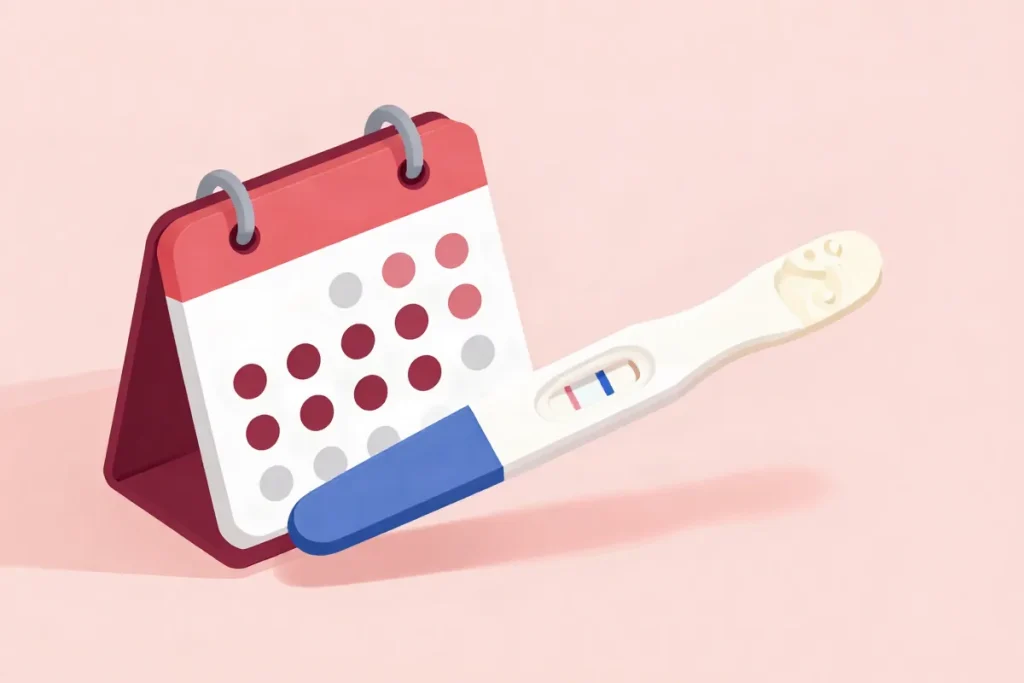
A faint second line on a test may mean you’re pregnant: the test reacts to the hormone hCG, which appears during pregnancy. But it’s important to read the result within the time stated in the instructions: a line that appears later may be an evaporation line, not confirmation of pregnancy.
If the result is unclear, repeat the test in a few days, following the instructions, or see a doctor for clarification. Let’s look at why the line may be faint, how to read the test correctly, and what to do next.
| Situation | What it may mean | What to do |
|---|---|---|
| Faint line within the reading window | It may be early pregnancy and a low hCG level | Repeat the test in 2–3 days |
| Result read contrary to the instructions | The reading may be inaccurate | Repeat the test and follow the reading window |
| Stale urine used for the test | The test may have been performed incorrectly | Repeat the test according to the instructions |
| The line remains faint or you have concerns | A home test alone may not provide certainty | See a gynecologist; discuss a blood test for hCG |
| Symptoms of possible complications | Medical assessment is needed | See a doctor for further evaluation |
- 2–3 days recommended interval before repeating the test
- 1–2 days retesting interval mentioned in the Kotex material
- after week 5 timing of the ultrasound stated in the Kotex material
What does a faint second line on a test mean?
A faint second line may mean you’re in the early stages of pregnancy, when hCG levels are still low. According to the Clearblue material, any line indicating a positive result, even a faint one, means “pregnant”; also follow the instructions for your specific test.
If the second line appears within the result-reading window stated in the instructions, treat the result as provisionally positive. Don’t read the test after this time: the result is only relevant if it appears within the time specified by the manufacturer.
What a faint line doesn’t tell you
The intensity of the line alone can’t tell you how far along the pregnancy is or how it is progressing. To check the result again, repeat the test in 2–3 days: that interval is stated in the provided material. If you’re unsure about the test’s accuracy or have worrying symptoms, see a gynecologist.
Why can an early pregnancy cause a faint line?
A faint line on a test in early pregnancy may appear because the level of hCG—the hormone the test detects—is not yet high enough to produce a strong line. So the line’s faintness alone can’t tell you how many days have passed since conception.
If the second line is faint, repeat the test in 2–3 days: hCG concentration may rise during that time, making the result more noticeable. When comparing tests, keep in mind the result-reading window stated in the instructions: a change in the line after this time shouldn’t be taken as confirmation of pregnancy.
If a repeat test in 2–3 days still shows a faint positive result, discuss it with a gynecologist. The intensity of the line alone can’t establish how far along the pregnancy is or how it is progressing.
How do you repeat the test in 2–3 days?
Repeat the pregnancy test in 2–3 days: this interval is recommended to allow hCG levels to rise and the faint line to become more noticeable. Use fresh urine—a test performed on a sample collected a long time ago may give an inaccurate result.
Before testing again, read the instructions for your specific product: different tests may have different procedures and result-reading windows. For example, don’t apply the directions for one test to another, and check the instructions in advance to find out when to read the result.
Read the test only within the time specified by the manufacturer. A line that appears after an arbitrary amount of time is no longer considered a reliable test result: don’t draw conclusions from the test after the stated window has passed.
What mistakes can affect the result?
The result of a pregnancy test can be affected by not following the instructions, using stale urine, or reading the line outside the specified time window. Even if the second line is barely visible, don’t use its brightness to judge how far along you are or whether you’re pregnant.
Before testing, use the test exactly as stated in its instructions: incorrect use may affect the result. Fresh urine is important; a stale sample is listed as one possible cause of a faint line. Read the result within the time window set by the manufacturer: reading it earlier or later makes the line harder to interpret.
What to do if you’re unsure about the result
If you’re unsure about the result’s accuracy, repeat the test in 2–3 days and see a gynecologist. Rely on repeat testing and a consultation, rather than comparing the shade of the line: its brightness alone can’t provide a reliable assessment of the pregnancy.
When is a home test result not enough?
See a gynecologist if you’re unsure about the accuracy of a home test or the faint line remains on a repeat test: a single test result may not be enough to clarify the situation. If you’re worried about how you feel, don’t delay seeking medical care.
What tests might a doctor recommend?
The Kotex material names a blood test for hCG and an ultrasound after week 5 of pregnancy as ways to confirm pregnancy. The timing of the ultrasound matters: don’t assume a home test replaces this examination or allows you to determine on your own where the pregnancy is developing.
With an ectopic pregnancy, hCG sometimes rises more slowly, and a test may show a faint line, according to the Euromed-invitro material. So if you have symptoms of possible complications, don’t rely on repeat home tests alone: see a doctor for further examination and monitoring.
What can’t a home test confirm?
A faint line on a home test can’t show whether the pregnancy is progressing normally: the test detects hCG but doesn’t assess the course of the pregnancy. The line’s faintness alone can’t tell you how far along you are or the embryo’s condition; a test result doesn’t replace a gynecologist’s consultation, a blood test for hCG, or an ultrasound.
How to clarify the result
Repeat the home test in 2–3 days: hCG levels may change in early pregnancy, making the line more noticeable. However, a repeat test confirms only the test result itself—it can’t establish where the pregnancy is developing or whether it is progressing normally.
A faint line alone doesn’t prove an ectopic pregnancy. The provided information says only that a test may sometimes show a faint line in an ectopic pregnancy; that result isn’t enough to make a diagnosis. If you’re still unsure after repeating the test, see a gynecologist for an assessment and to discuss whether you need a blood test for hCG and an ultrasound.
Frequently asked questions
Does a faint second line mean I’m pregnant?
When should I repeat a pregnancy test?
Should I see a doctor if the line is faint?
Can a faint line be caused by an error?
Key takeaways
- A faint line read within the specified window is considered a positive result.
- Repeat the test in 2–3 days and follow its instructions.
- Stale urine and reading the result at the wrong time can affect the result.
- If you’re unsure, see a gynecologist; options for confirmation include a blood test for hCG and an ultrasound after week 5.
Sources
- What to do if you’re pregnant — “What to Do If You’re Pregnant”
- huggies.ru — “Faint Line on a Pregnancy Test”
- ru.clearblue.com — “What a Faint Line on a Pregnancy Test Means”
- kz.kotex.com — “Frequently Asked Questions About Pregnancy Tests”
- euromed-invitro.ru — “Pregnancy Test: Frequently Asked Questions and Answers”
