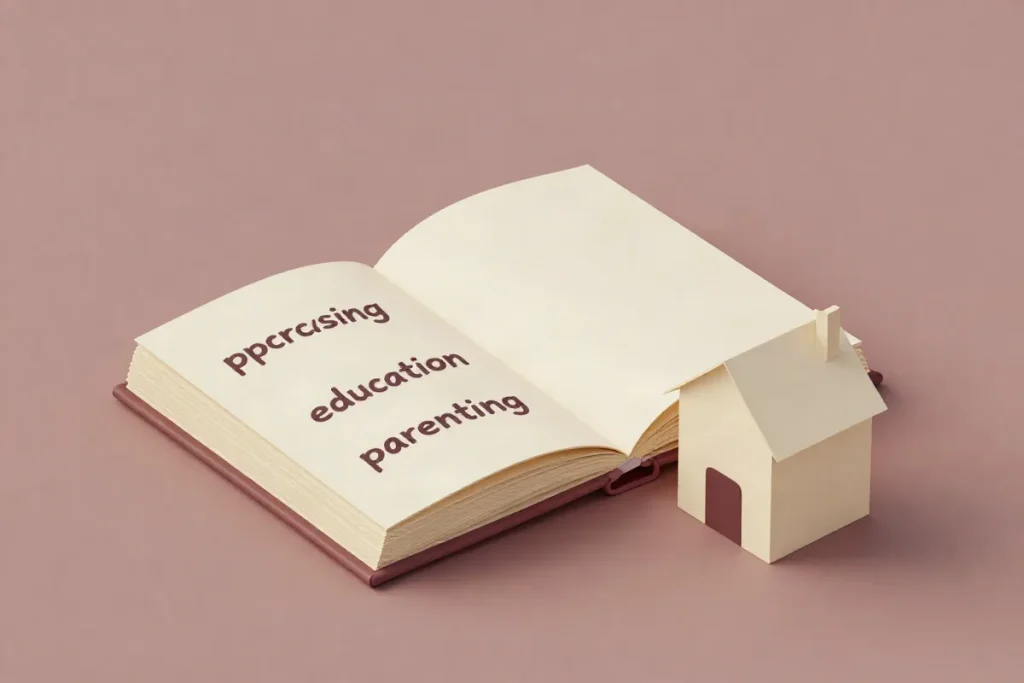
The Russian word «воспитание» is usually translated as upbringing: it refers to how a child is raised, taught how to behave, and helped to absorb values. For example, a good upbringing means good воспитание, and children’s upbringing means raising children.
Upbringing is appropriate when talking about family upbringing and the conditions in which someone grew up. In this article, we’ll look at the word’s meaning and examples of how it is used. For more on the aims and approaches to raising children, see our overview, “Education and Raising a Child: Goals, Approaches, and the Role of the Family.”
| Word | Main meaning | Example |
|---|---|---|
| upbringing | Family experience of growing up | a strict upbringing |
| education | Education or learning | school education |
| parenting | Parenthood and child-rearing practices | parenting a child |
- 3 words are the main options to compare: upbringing, education, and parenting
- 3 examples of upbringing used in a family context appear in the article
- 2 contexts—family experience and parental actions—call for different English words
How do you translate «воспитание» into English?
The Russian word «воспитание» can be translated as upbringing, education, or parenting, depending on the meaning. For family upbringing, upbringing is usually the best fit: She had a strict upbringing means she was raised strictly.
The English words emphasize different things. Upbringing describes how someone was raised and what they were taught at home; education usually means education or learning, such as schooling, though in some contexts it can also encompass upbringing. Parenting means parenthood and the practices parents use: the word emphasizes the process and approach, not just the kind of person a child grew up to be.
- Upbringing: Her upbringing taught her to be polite means her upbringing at home taught her to be polite.
- Education: Education is important may refer to education in general; if the intended meaning is the development of habits and norms, this word alone may not be enough.
- Parenting: Parenting can be challenging refers to parenthood and parents’ everyday responsibilities.
In Russian, «воспитание» covers both the development of habits and the learning of norms. The right translation therefore depends on what the sentence describes: the family environment, learning, or parents’ actions.
How is upbringing different from education and parenting?
The English words upbringing, education, and parenting refer to different aspects of growing up and learning: the experience a person gains in their family, education, and parents’ actions, respectively. They are therefore not interchangeable translations of the Russian word «воспитание».
- Upbringing describes how someone grew up and the kind of upbringing they received in their family: She had a strict upbringing means “She was raised strictly.” This refers to the experience of growing up, not just what someone learned at school.
- Education is appropriate when the meaning is education or learning, for example at school: My education began at school means “My education began at school.” The emphasis here is on the start of learning, not on parents’ methods.
- Parenting refers to parenthood and how parents care for their children, make decisions, and raise them: Parenting takes patience means “Raising children takes patience.”
When choosing a word, check exactly what the sentence describes: family experience someone has already had—upbringing; schooling or other learning—education; or parents’ actions and decisions—parenting. For example, a strict family upbringing can be called a strict upbringing, but parenting is more natural for a process that requires patience from parents.
How do you use upbringing in a family context?
The word upbringing is used to talk about how the family environment influenced someone and what they learned as a child. For example, “My parents gave me a good upbringing” means “My parents raised me well.” It refers to being brought up in a family, not to a single lesson.
The phrase “Their upbringing was different” means “They were raised differently” and emphasizes differences in their experience of growing up. In “A child’s upbringing matters”, the form child’s indicates whose experience is being discussed: that of a particular child.
If you want to explore the aims, approaches, and role of the family beyond translation, read “Education and Raising a Child: Goals, Approaches, and the Role of the Family.”
What mistakes are common when translating words about raising children?
Mistakes happen when upbringing, education, and parenting are treated as interchangeable: the first describes the family experience of growing up, the second can refer to learning, and the third to parenthood and adults’ actions. When translating words about raising children, check what the sentence is actually about: school, family life, or parents’ everyday decisions.
Checking the meaning in context
- «Строгое воспитание» — strict upbringing. The phrase strict education can shift the meaning toward formal learning; strict upbringing is more precise for family experience.
- «Воспитывать ребёнка» — parenting a child, when referring to parents’ actions. For example, a discussion of adults’ daily decisions is about parenting; translating it simply as “upbringing” may lose the sense of parenthood.
- «Опыт взросления ребёнка» — a child’s upbringing. The focus here is not on one particular action by a parent, but on the family experience in which a child grows up.
- Education means learning when the context is about school. If the sentence describes family experience, using education instead of upbringing can incorrectly shift the meaning toward schooling.
When translating, first work out what the Russian phrase means: family experience, learning, or parents’ actions. For example, the key idea in «строгое воспитание» is family experience, while in «родители воспитывают ребёнка каждый день» it is what the parents do. This context helps you choose between upbringing and parenting.
When is one English word not enough?
One English word is not enough when it matters whether you mean family upbringing, school education, or specific actions by parents. Upbringing usually refers to the environment in which a child grew up and the people who influenced them, but it does not necessarily describe how someone interacts with the child. If parents’ actions and approaches are important, parenting is more precise.
The word education can refer to formal education, so a phrase about a child’s education does not necessarily describe upbringing within the family. Compare the three terms: upbringing is the family environment a child grew up in; parenting is parents’ practice; education is education, including schooling. This distinction helps you choose a translation based on meaning instead of using the same English word for the Russian term in every situation.
How to avoid ambiguity
When translating, first identify what the sentence is about: family, school, or parenting practice. If one noun is not enough, replace it with a clear description: “how the parents raised the child” conveys the family experience, while “what they learned at school” describes the content of their schooling. These formulations make it clearer which actions or circumstances you mean.
Frequently asked questions
How do you say «воспитание» in English?
What does upbringing mean?
Can «воспитание ребёнка» be translated as education?
How do you say «родители хорошо меня воспитали» in English?
Key takeaways
- Upbringing means family experience of being raised and growing up.
- Education is usually associated with education and learning.
- Parenting refers to parenthood and child-rearing practices.
- The translation of «воспитание» depends on the context: family, school, or parents’ actions.

We use cookies for analytics to understand how visitors use the site. Accept, reject, or choose which categories to allow.